
Extinction is a word which has an uncomfortable air of finality about it, rather like death! Whereas people are rarely unanimous in their definition of the word CONSERVATION, there can be no doubt that to practically everyone (including quite young children) extinction means to be wiped out and completely destroyed. To become extinct is to be gone forever. In fact the process of extinction follows this simple rule:
"A Species Becomes Extinct when its
Death rate is Continually Greater than its Birthrate".
Nearly 1/4 of mammals and 1/3 of amphibians are in danger of becoming extinct.
Extinction generally occurs under one of three headings:
1. Natural Extinction
This happens when a species declines in numbers gradually but steadily at the end of its evolutionary period on earth. The length of the period depends largely on the success of the species as a whole and its ability to adjust to changes in climate and vegetation and the appearance of predators or (in the case of predators) the disappearance of prey. It is thought that 90% if all organisms that ever lived on earth are now extinct. It is worth remembering that a species dying a natural evolutionary death is nearly always replaced by new forms or groups.
This occurs when Humans destroy animals in such numbers that they become completely exterminated and cease to exist as a species. The motivations for destruction on this scale can usually be attributed to one of the following reasons: (i) profit (and often - greed), (ii) competition with animals for food, habitat or both, or (iii) the sheer enjoyment of killing. We kill animals for their meat, oil, hides, fur, feathers, shells or eggs. We trade in live animals; often at the expense of a dwindling population in the wild state. Some animals are killed because of superstitious dread; others are killed to provide souvenirs for tourists. Animals are still being killed by trophy hunters and by those who take pleasure in dispensing death (from a safe distance).
Many of the species now facing imminent extinction do so not because people have set out to destroy them - but rather because they have stepped in the path of his "progress". Of all the causes of indirect extinction the most widespread and devastating must be the destruction of habitat.
Five phases of huge natural extinctions are thought to have occurred over the earth’s history and many think that we may be in a sixth phase as current extinction rates are an estimated 1,000 to 10,000 times higher than the natural rate. This phase is unique in that the causes of these mass extinctions are largely due to the activities of mankind.
In summary, the reasons why animals are endangered are due to: hunting, unsustainable fishing methods, loss and fragmentation of habitat and degregation of habitat through pollution, plus climate change is becoming an increasingly important factor. Invasive species and disease also play their part.
Its hard to tell exactly how many species are becoming extinct when we don’t know exactly how many there were in the first place. Even a handful of trees in a rainforest eco-system could contain numerous previously unidentified invertebrates. Between 1.4 and 1.8 million species have already been officially identified so the number of species could be anything between 10 and 100 million species, or more, the most widely accepted figure being 15 million. Based on this figure, with an estimated 0.01 and 0.1% of species become extinct each year this would amount to between 1,500 and 15,000 species becoming extinct each year!
With the human race multiplying at the rate of 230,000 people every day, the destruction of tropical rain forests at the frightening rate of between 90 - 150 acres per minute and the probable loss of approximately 800 square miles of wild habitat each day to human needs - it is hardly surprising that there are so many endangered species of animals and plants.
It is interesting to look at the way in which the disappearance of animal species in ever-increasing numbers is related to the steady increase in the size of the world's human population over the past three hundred years. The figures look like this:
17th Century
By the middle of the century there were about 450 million humans on earth and 7 animal species became extinct.
18th Century
550 million humans on earth and 11 more species became extinct by mid-century.
19th Century
By 1850 the human population had increased to 900 million and 27 species were lost.
20th Century
Extinct - a species is totally extinct
Extinct in the Wild - there may be some species in captivity but none surviving in the wild. Sometimes successful captive breeding programmes can release species back in to the wild as occurred with Prezwalski’s horse which was reintroduced to Mongolia.
The following three fall under the threatened category:
Critically Endangered - the species faces an extremely high risk of extinction.
Endangered - a species faces a very high risk of extinction.
Vulnerable - the species faces a high risk of extinction in the wild.
Near Threatened - a species doesn’t fall under the threatened category but is close to or likely to enter that category in the future.
Least Concern - not threatened - a species in this category could be considered to be widespread and abundant.
Data Deficient - not enough information to make an accurate assessment.
55,926 species of plants and animals were assessed by the year 2010, both threatened and non-threatened. Of these at least 18,351 were considered to be threatened species, about a third of the species they evaluated. This is a small fraction of the total number of species in the world but gives a useful picture of the state of the world’s biodiversity, as well as an assessment of individual species. Animal species are covered much more than plants, particularly mammals while other areas such as marine species have not been covered in so much detail.
The following figures should the percentage of threatened species in each major group of organisms. Out all all the species evaluated plants and amphibians appear to be the most threatened. The remainder aren’t necessarily abundant as they may be near threatened or lacking in sufficient information to make an accurate assessment (data deficient).
Mammals - 21%
Birds - 12%
Reptiles - 21%
Amphibians - 30%
Fish - 21%
Invertebrates - 30%
Plants - 68%
Fungi and Protists - 33%
Activities & Projects
Suddenly, the word EXTINCTION has not one, but several possible definitions depending upon the species being studied or discussed and the reason for its decline or extermination. As teachers will very quickly appreciate, this opens up a wide-ranging subject for class or project work of all kinds, suitable for any level of age or academic ability.
There are many absorbing activities linked with the study of extinction ranging from simple model making and artwork to detailed studies of ecosytems, or deductions concerning climatic changes which brought the Age of Reptiles to a comparatively abrupt end.
An interesting study for both individuals and groups is the compilation of typical case histories showing why plants and animals are endangered or why they have become extinct.
These case histories could include any of the following:
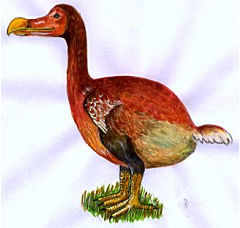
Dodo (extinct)
The flightless pigeon of Mauritius.
Tiger (critically endangered - endangered)
Fifty years ago there were more than 100,000 tigers - now there are approximately 3,200 left and the chances of survival are not good.
Passenger pigeon (extinct) A classic example of direct extermination. Countless millions of these birds were killed within 30 years in North America, the last one died in 1914.
Quagga (extinct)
A variety of zebra with stripes at the front of its body. It lived in large numbers in South Africa until Boer settlers began hunting them. They were finally wiped out in 1878.
Rhinoceros (near threatened - critically endangered)
Any of the five species will make an interesting study. In evolutionary decline - being accelerated by poachers who sell horn (which is attributed with magic powers).
Great whales (least concern - endangered)
Humans' predation on the whales from the earliest times to the present day provides scope for a very detailed and well documented study.
Hawaiian goose (Ne-ne) (vulnerable)
Success story. Down to last thirty survivors before Wildfowl Trust commenced rescue programme. Now increasing in numbers and released again in Hawaii.
Remember that Humans too can become extinct, and there are already too many records of tribal extinction around the world.
According to Survival International 150 million tribal people live in over 60 countries around the world. Although their land rights are protected under international law, on a local level this is not the case. Many tribes are in danger of being wiped out by diseases brought in by outsiders, particularly if the tribes do not have contact with the outside world (of which there are about 100)and sometimes suffer violence at their hands. Few remain particularly in the rainforests where they are vulnerable to the exploits of miners and logging companies. When tribes are destroyed, so is their language, culture and knowledge which has built up over thousands of years.Conservation Education - download this magazine “Endangered Animals of the World”. http://www.ypte.org.uk/downloads.php
Useful YPTE Links:
Britain’s Disappearing Habitats http://www.ypte.org.uk/environmental/britain-s-disappearing-habitats/40
Endangered Animals of the World http://www.ypte.org.uk/environmental/endangered-animals-of-the-world/24
Endangered Wildlife http://www.ypte.org.uk/environmental/endangered-wildlife/26
Environment - how can you help protect it? http://www.ypte.org.uk/environmental/environment-how-can-you-help-protect-it-/81
Rainforest Animals http://www.ypte.org.uk/environmental/rainforest-animals/90
Rainforest Tribes http://www.ypte.org.uk/environmental/rainforest-tribes/92
Save The Plants http://www.ypte.org.uk/environmental/save-the-plants/31
Trade in Endangered Species http://www.ypte.org.uk/environmental/trade-in-endangered-species/25
World Conservation Problems http://www.ypte.org.uk/environmental/world-conservation-problems/20
Last Updated 25th February 2011.
